![]() |
![]() CDROM VERSION POSTER STORE ABBOTT ANSEL ADAMS ROBERT ADAMS ALVAREZ BRAVO ATGET BELLOCQ BLOSSFELDT BOURKE-WHITE BRANDT BRASSAÏ CALLAHAN CAMERON COBURN CUNNINGHAM DeCARAVA DOISNEAU EGGLESTON EVANS FENTON FRIEDLANDER GOWIN GUTMANN HILL&ADAMSON HINE KARSH KERTÉSZ KLEIN KOUDELKA LANGE LARTIGUE LAUGHLIN LEVITT MAPPLETHORPE MEATYARD MEYEROWITZ MODEL MODOTTI MUYBRIDGE NADAR NEWMAN O'SULLIVAN OUTERBRIDGE PARKS PENN RIIS RODCHENKO SALGADO SHERMAN SHORE SMITH SOMMER STEICHEN STIEGLITZ STRAND TALBOT UELSMANN WALDMAN WATKINS WESTON WHITE WINOGRAND WOLLEH |
![]() Text from Jane Livingston, The New York School: Photographs, 1936-1963 "William Klein's book New York was made in an intense eight-month period in 1954-1955, it was also during this period that the photographer began what would be a twelve-year relationship with Vogue magazine. Klein had met Vogue's art director, Alexander Liberman, in Paris. According to Klein: Liberman said, "If you ever come to New York, come to see me and you can become, like, an art director or something at the magazine. It will give you a way of making a living. My preoccupation is painting and sculpture, but I make a living at Vogue, which gives me free time to work. It's something maybe you could do." I thought, why not. I didn't like the idea of trying to sell oneself as a painter, buttering up to collectors, curators….I liked the idea of making a living with one hand and doing exactly what you wanted with the other. Vogue and Conde Nast, at that time, had a tradition of cultural patronage. Whatever, I felt this relationship was more comfortable than grant-hustling.Klein's attitude toward his work for Vogue in relation to his personal work - unlike that of, say, Louis Faurer, who sometimes felt that he had "sold out" - is characteristically pragmatic; like Richard Avedon, he seems never to have apologized for any of the commercial work he saw fit to do. When he arrived in New York in 1954, Klein recalls: Liberman asked me, "What do you want to do?" I said, "A book of photographs on my return to New York. A sort of photographic diary." And he said, "That sounds interesting - we'll do a portfolio and foot the bill." And they did - paper, film, labs, enlarger - it was surreal and funny. Here was this fashion magazine financing photographs which were probably the funkiest and most unpublishable of the day, and although Liberman seemed to like them, that portfolio never got done. But in 1954, a double page on me was published: an abstract photo and an almost illegible Parisian picture, under the title A New Photo Graphic Eye. Not something Vogue would do nowadays.Actually the story of William Klein's return from Paris to New York to make the book that established him as the unique photographic figure he is now universally acknowledged to be came about through a more circuitous series of events than the Vogue Connection: In 1953, 1 learned about a new process developed by Corning Glass where photographs could be transferred into, not on the surface of, but into the mass of glass. Up to then, it had only been used to put your grandmother's face into a locket. But I thought, wait, my abstract photos could become glass murals, facades, a new kind of stained glass window. Okay, new vision, new materials, let's go to New York and see.Klein's original aspiration was to be a painter. In Paris during the early 1950s, he studied briefly with Fernand Leger, whose freeing ideas, he says, were more interesting to him than his paintings. Obviously many young Americans gravitated to France during the postwar years; a number of separate, sometimes overlapping expatriate groups formed, circulating in France, Italy, and Spain, usually returning again and again to Paris. Klein seems to have been focused more on acquiring a serious education in avant-garde art than in being a part of the international literary/artistic scene. His closest friends in his early days in Paris were two other aspiring American artists, Ellsworth Kelly and Jack Youngerman. For all their differences in style and temperament, and despite the fact that the two migrated in opposite directions, Klein's career parallels that of Robert Frank in several ways. Both artists have at times in their careers inhabited circles of vanguard painting and sculpture. Both used photography in their earlier years very much in the same spirit modernist painters or sculptors might experiment with their media to make them transcend the traditions of a given medium; both made an intensely original body of still photographs over a period of just three or four years before becoming primarily filmmakers; both, at around the same time. found ways to make ambitious books; and both speak of their photographs in the language not of traditional photography but of avant-garde artists. Klein in fact "discovered" photography through involvement with other media. In 1952, he was working on a project in Milan that involved a mural made with sliding and revolving panels: At one point I photographed the turning panels. While they revolved, using long exposures, the geometrical forms blurred. It seemed to me that blur gave another dimension to the lines, squares and circles we were all playing with and was a way out of a hard-edged rut. I was intrigued by what could be done with a camera - or even without a camera. I saw how I could go one step further creating forms in a darkroom. I cut out basic figures in black paper, projected light through them and literally drew with light on photographic paper. The results were then photographed, blown up and used wall size.At wouldn't seem inevitable." he says,
when I went to Paris to paint, that in 1954 I'd be doing a book in New York. Yet looking back, it all fits in pretty well. It has to, of course. But look, Paris, as an art center, after the war, was catching up with the twentieth century. And so was I. I spent some time with Leger, who was for a few of us the only modern French painter around - someone who did sets, costumes, murals and films as well. He invented the concept and phrase, The New Landscape, which was the title of a Gyorgy Kepes book recently published in Chicago which we were all devouring in Paris. Like Moholy-Nagy's Vision in Motion. We'd come to Paris with romantic visions of ateliers, cafés and bohemia and were now into Bauhaus speak. New Vision! New materials! Aluminum! Plastic! Space-form structures! Light paintings! Kinetics! Science and Art! Talking about catching up with the future.In elaborating on the influences he was experiencing during these years, Klein mentions a series of ideas and individuals whose importance to American artists of the time impinges on the entire phenomenon of the New York School, not just in photography but in painting, sculpture, design. "I did everything, all the way," he says.
When I turned to photography I turned completely. My references? Sander, Man Ray, Raoul Haussmann, Bill Brandt, the FSA, Riis, Moholy-Nagy, Rodchenko, Marey, Walker Evans, Muybridge, Lewis Hine, Weegee, John Heartfield - as well as Charlie Chaplin, von Stroheim, Orson Welles, and always Dziga VertovBut even before this "turning completely" to photography, Klein had immersed himself in other arts.
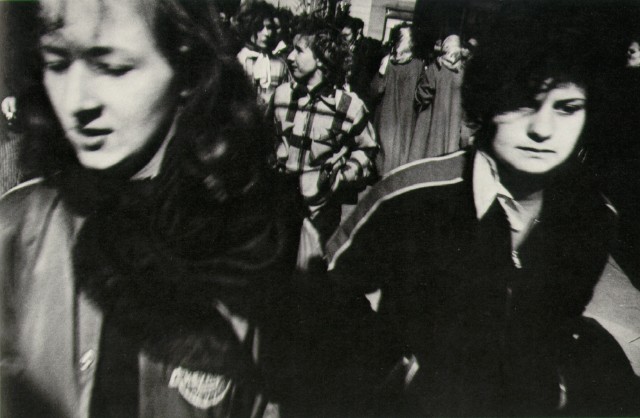
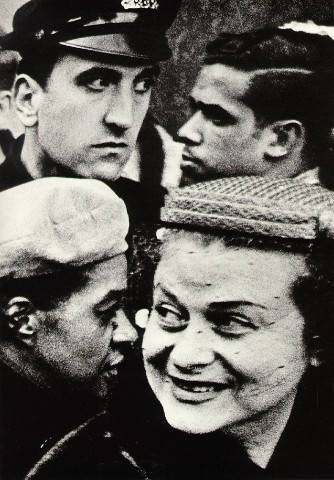
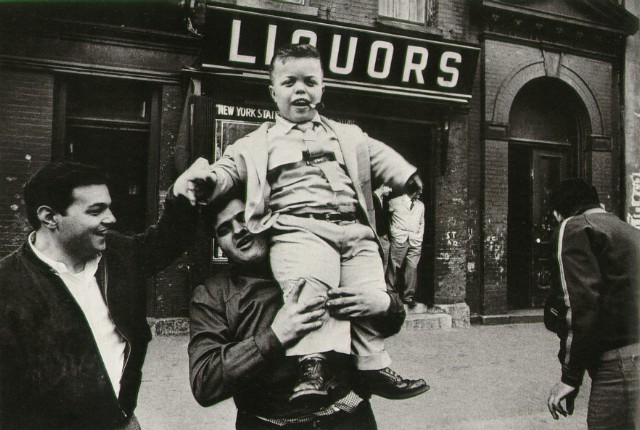
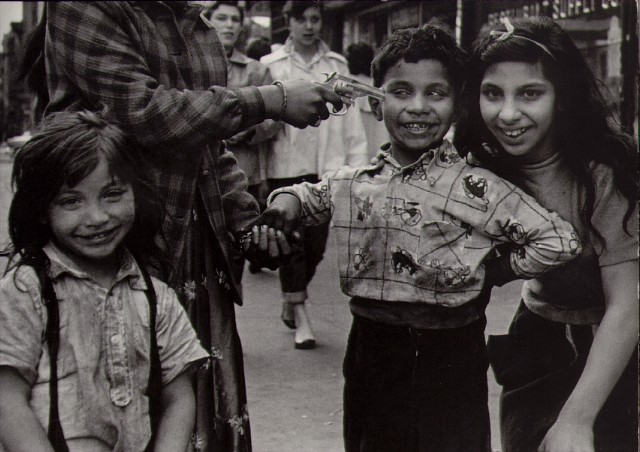
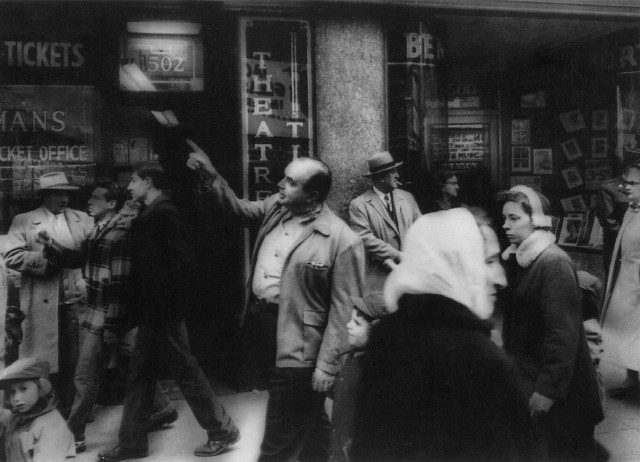
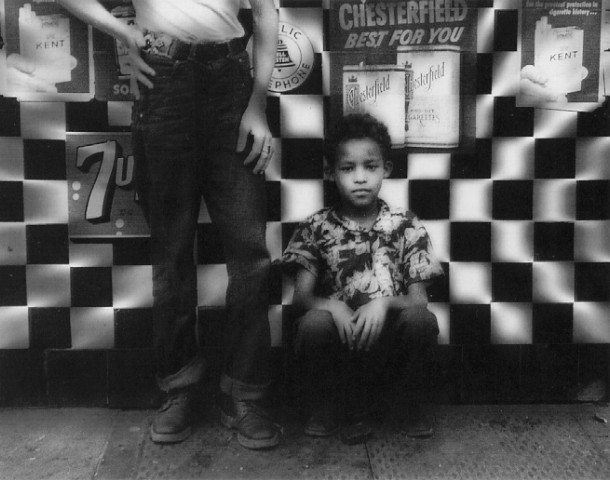
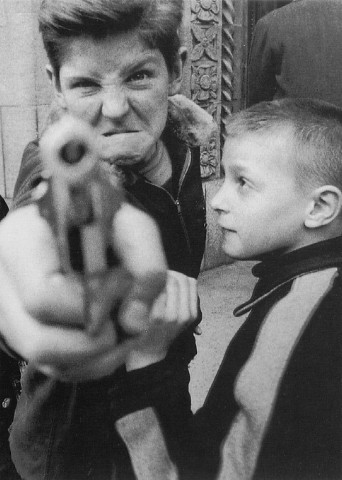
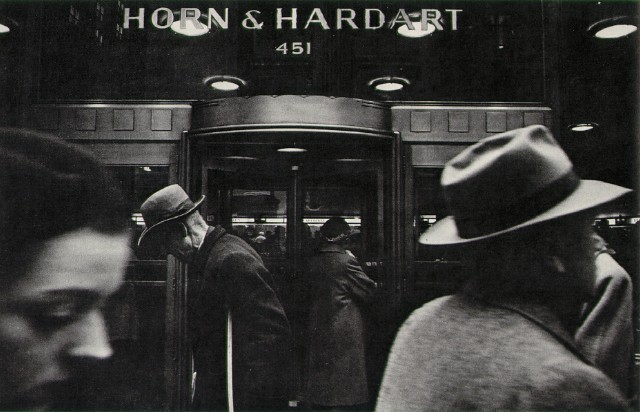
Leger had been left behind, like Mondrian and de Stijl. And on the trail of Mondrian, I'd photographed black-and-white grid barns on the Island of Waalkeren where he'd spent the First World War. They were my first published photos, by the way, in Domus and in Vogue. And then, onwards, past Tauber-Arp, Rodchenko, Malevich, the Constructivists, and, after an anarchic, regressive while, Dada. Then back to and in and out of the Bauhaus. A couple of us made the pilgrimage to Zurich to see Max Bill and Richard Lohse. Pity, no Bauhaus in Paris - architecture plus typography plus design-for-life plus cinema plus photography were right up my alley. But where did photography fit into this triumphant march to the modern? Everywhere. First, it was defined as the organization of meaningful visual signs, so what's wrong with that? Then, it was a new frontier. Something to be explored, with experiments in light, light creations and so on. Then art would have two faces: biological and social, with the artist as seismograph. I felt, okay, no problem, so photogra-phy would be on the agenda as well.Klein recalls that he was very consciously trying to do the opposite of what Cartier-Bresson was doing. He did pictures without intervening. He was like the invisible camera. I wanted to be visible in the biggest way possible. My aesthetics was the New York Daily News. I saw the book I wanted to do as a tabloid gone berserk, gross, grainy, over-inked, with a brutal layout, bull-horn headlines. This is what New York deserved and would get. The thing I took as my inspiration was all over the place, three million a day, blowing in the gutter, over-flowing ashcans, the New York Daily News. An old buddy. [In high school] I'd done a whole issue of the school paper parodying that paper. I decided to be visible, intervene, and to show it. Shades of Brecht but also the Daily News' Inquiring Photographer. I was never after news, of course, just the dumbest, most ordinary stuff. But I liked, as further distancing, the garish urgency of their front-page scoops. So I would try to photograph schlock non-events like some crazed paparazzo and print it accordingly.Klein's description of his technical approach to the New York book captures what might be called the epitome of the New York School aesthetic: The New York book was done with one camera, a 35mm camera, and three lenses. I had a 28mm, a 50mm and a 135. The funny postscript to all this is that I wanted to buy a 35mm camera, because I knew I was going to New York, and I'd been using mostly Rolleiflex. I went to this pictorial service, Magnum, to see whether somebody was selling a second-hand camera. I ended up buying Cartier-Bresson's camera from him because he was getting a whole new set of cameras, so he sold it to me.The books New York, Rome, and Tokyo seem, even from a distance of nearly forty years, impossible achievements for someone coming from a more conventional photographic training and apprenticeship. Like the other two books, New York is simply too blastingly confrontational, too graphically harsh, too extreme in its disregard for such things as tonal values to conform to any of the medium's supposed norms. And yet it has its lyrical moments. It is a book informed by an enormously daring use of painterly values, graphic surprises, and literary twists - and yet whose essence is purely photographic. Klein uses camera and film and design in such a direct and almost naively confident way that one almost feels something of what it was like to be in that place at the moment the film was exposed. More pointedly, the accidental and crazy and exhilarating revelations sensed in the photographs also controlled the laying out of the book - and the sequencing itself becomes one of the subjects of the book. The initial response to New York seems in some ways to have been like the response to Frank's The Americans in that it quickly became a cause celebre, and it was immediately perceived to create a new category. Yet, at least in Europe, it may have had even more impact in its early years than Frank's book. Like The Americans,New York was published first in France. After France, it was published in England and in Italy. There was a great deal of controversy, but a certain success, the Prix Nadar, lots of cover newspaper stories, portfolios all over. In Japan it immediately became a cult book. The photographic establishment ignored it. But I never met a U.S. photographer of that period who didn't somehow have a copy.When my book came out, Klein recalls, it was published by publisher that had a category which was travel books, and my book was in that category. Because you didn't have photographic essay books. And my book was like a photographic story. I mean, there were chapters. I added the last chapter, which was cityscapes, and I felt I had to do it because since this was a travel book, people would have to see what New York looked like. But that last chapter was the thing that gave me the most trouble.Despite its notoriety, as Klein himself admits, New York's deliverance into the world was not only largely ignored by the photography establishment, but, at least by the academy, positively disliked. I think what people resented most was not the photographs per se, but the fact that it was a book. I mean, to see, between hard covers, the kind of photographs a lot of people threw away…When the book came out, I was invited to photo clubs to address the members, and I found there would be no dialogue. They would have their photographs of old women, and so on, and then I would show my photographs and they would be mostly interested in how come with such terrible photographs you can become famous and have a book published?After New York, Klein would go on to do three other books, Rome, 1958, Moscow, 1959-1961, and Tokyo, 1961. Together, these works fully express Klein's strikingly original achievement as a still photographer, and presage what was to come in his films. Their lush printing in photo-gravure, far from mitigating the ominous, excessively dark and contrasty nature of the photographic prints, enhances these qualities. Klein cultivates extreme, sometimes obliterative, black tones in his work in the same way other photographers go for richly variegated detail. Often there is the sense that a great deal of incident is literally lost in the shadows of a Klein image - yet shadows are not the point. The harshness Klein seems to be after is like the glare of direct sunlight rather than the dankness or gloom of the late-afternoon picture. It is a harshness, moreover, achieved at significant cost to "photographic values". The use of extreme blacks is far from the only weapon in Klein's arsenal. He will sometimes use a grayed-out graininess characteristic of certain black-and-white 35mm films, not for a muting or softening effect, butl for its sheer grittiness. As do other photographers of the New York School - Weegee, Model, Levinstein - Klein often pushes the camera up against his subject. He occasionally creates images whose airlessness, whose compacting of faces and bodies and bizarre pieces of' clothing, make Grossman's or Model's most clogged images look conventionally spacious. And he occasionally combines techniques of audacious image-framing and cropping with more radical darkroom methods. Many of the imagesin New York seem to have been solarized, or somehow reversed-to-negative, to create a look of forbidding "surreality." Yet it is never that decorative Surrealisin of so many of Man Ray's solarized images; rather, Klein confronts us with a stark, uncomfortable vision of a frantic, violent, catapulting existence - life in the city as theatre noir.
|
Buying through this link supports Masters of Photography
|