![]() |
![]() CDROM VERSION POSTER STORE ABBOTT ANSEL ADAMS ROBERT ADAMS ALVAREZ BRAVO ATGET BELLOCQ BLOSSFELDT BOURKE-WHITE BRANDT BRASSAÏ CALLAHAN CAMERON COBURN CUNNINGHAM DeCARAVA DOISNEAU EGGLESTON EVANS FENTON FRIEDLANDER GOWIN GUTMANN HILL&ADAMSON HINE KARSH KERTÉSZ KLEIN KOUDELKA LANGE LARTIGUE LAUGHLIN LEVITT MAPPLETHORPE MEATYARD MEYEROWITZ MODEL MODOTTI MUYBRIDGE NADAR NEWMAN O'SULLIVAN OUTERBRIDGE PARKS PENN RIIS RODCHENKO SALGADO SHERMAN SHORE SMITH SOMMER STEICHEN STIEGLITZ STRAND TALBOT UELSMANN WALDMAN WATKINS WESTON WHITE WINOGRAND WOLLEH |
![]() Text from Jonathan Green, American Photography : A Critical History
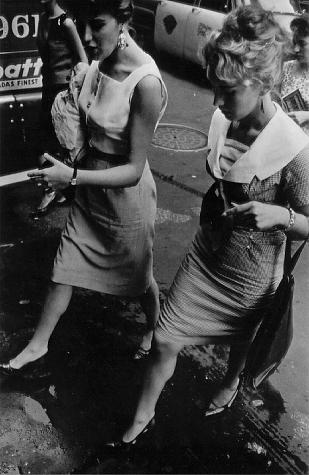
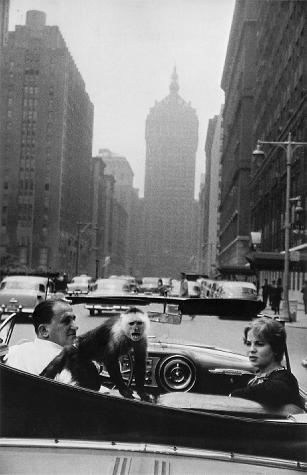
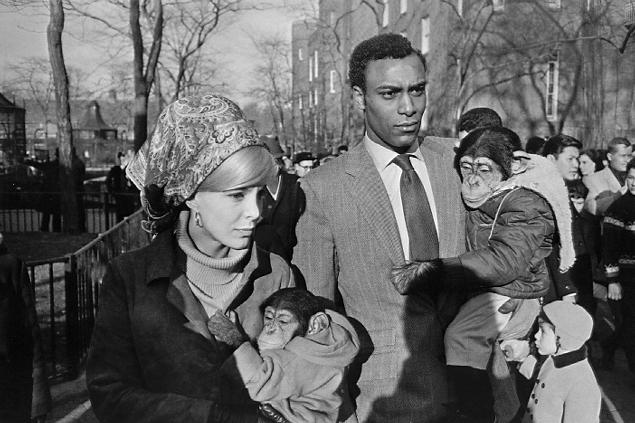
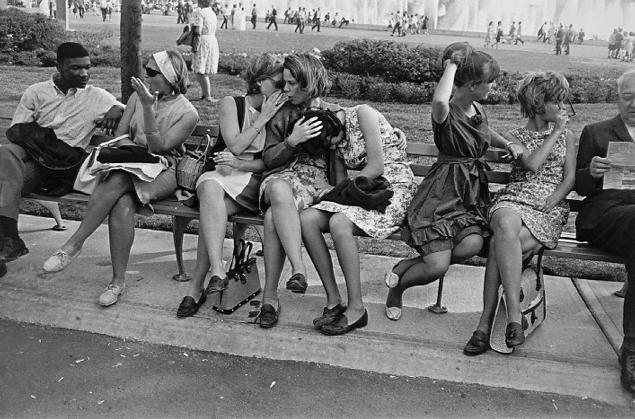
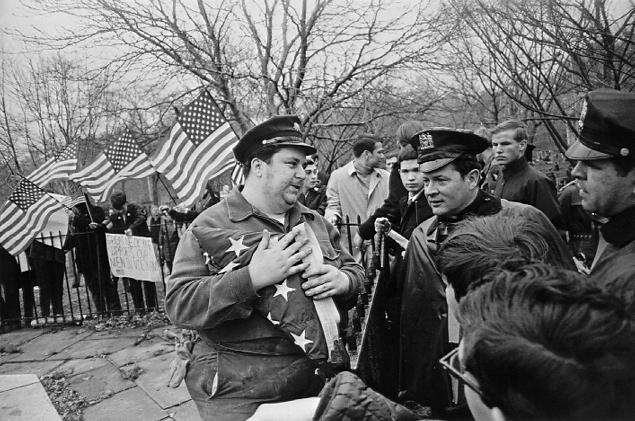
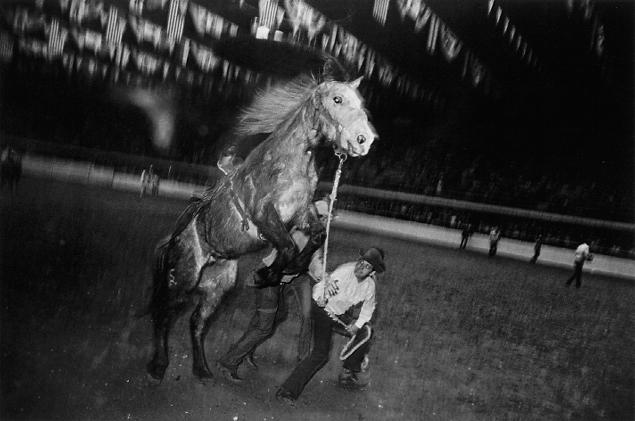
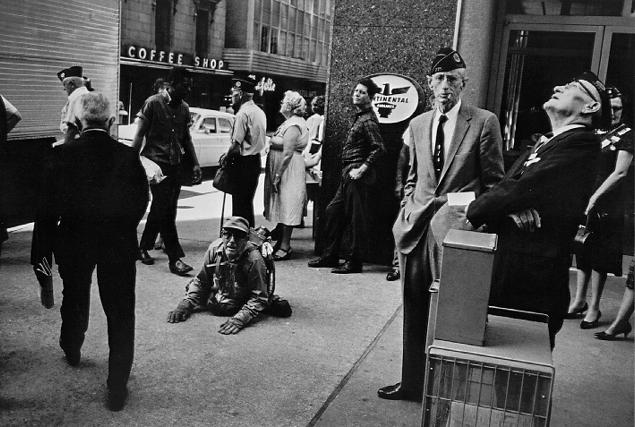
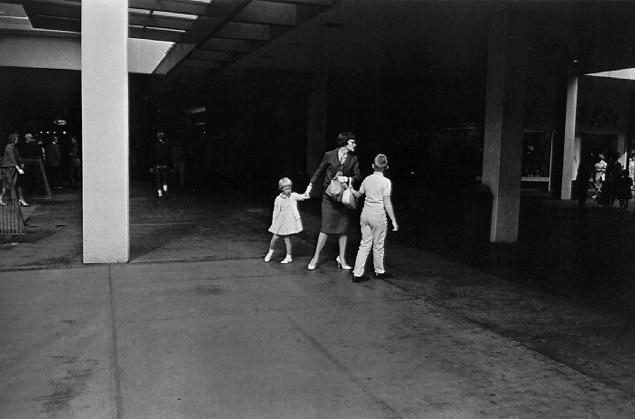
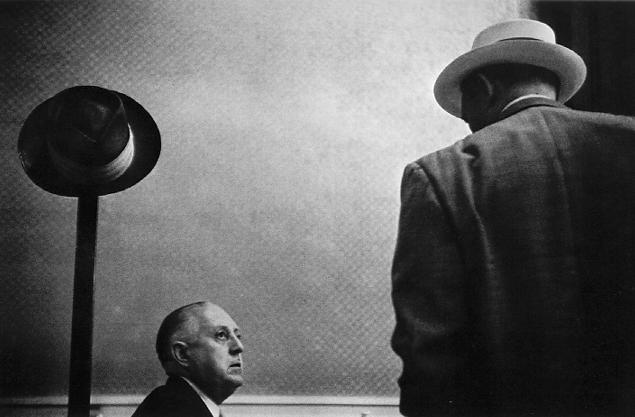
Garry Winogrand: Quick Takes and the Demotic EyeIf Friedlander synthesized the documentary and expressionist traditions, then Winogrand synthesized the documentary and photojournalist traditions. Indeed his own background includes working for almost twenty years as a free-lance photojournalist for Sports Illustrated, Fortune, Look, Life, Carriers, and Pageant. Winogrand's noncommercial photographs come from that same public world which is the province of photojournalism. In newspaper jargon, his photographs are a series of "quick takes." They have the look and feel, the looseness and spontaneity of an "honest" shot. They are essentially narrative images of "human interest." Tod Papageorge has called them "proverbs, fables, jokes." They are "stoppers": provocative shots that "catch and hold the reader's eye." They show "more than meets the eye." Because of their humanity, they could easily be used to build up a picture story. Because of their wit, it would not be surprising if they turned up as Life's last spread: "Speaking of Pictures."The fastidious intelligence that informs Winogrand's pictures comes not from photojournalism, however, but from his classic predecessors. From Atget and Evans, Winogrand learned an abiding respect for lucidity within complexity and for clear, coherent description. Atget convinced Winogrand of the need for truth; in Evans's work Winogrand first recognized the distinction between photography and the world. From them and from Frank, Winogrand learned the compatibility of documentation and the personal viewpoint. It was Frank who showed the visual possibilities of the wide-angle lens and radical camera orientation. Winogrand's tilt, rapid firing, and camera agility parallel Frank's willingness to follow the hand camera's own unprecedented framing. It is also Frank, of course, who first explored Winogrand's essential subject matter: the inhabitants of the American city and the American street. Winogrand has acknowledged his debt to Evans and Frank, but there is also an unacknowledged debt to the New York Photo League. From this group, which stressed the use of photography as a social document and vehicle for change, Winogrand inherited his commitment to social observation and commentary. Winogrand's images contain constant echoes of the radical journalism and form that defined Aaron Siskind's Harlem Document of the late thirties, Sid Grossman's snapshotlike images of Coney Island, and the images of the streets of New York by Sol Libsohn, Arthur Leipzig, and Winogrand's early friend Dan Weiner. Rounding out Winogrand's lineage are the Europeans Brassaļ and Cartier-Bresson and the American photojournalist Weegee. From Brassaļ and Weegee and from scores of anonymous newspaper photographers, Winogrand derived the merciless, primitive power of the flash, an eye for the disreputable and the dispossessed, and a sensitivity for caricature and subtle violence. It is indeed to Weegee that one must look to find an equally raw, concise, tabloid view of American life. Cartier-Bresson, too, has shown Winogrand the possibilities of moving beyond social comment to social satire. Winogrand's "decisive moment," like Cartier-Bresson's, is frequently tragicomic. But where Cartier-Bresson's wit, grace, and nuance are peculiarly French, Garry Winogrand's temperament is fiercely American. For Winogrand, street photography is a Rabelaisian enterprise of broad, coarse humor and uncomfortable confrontations. Winogrand's tragicomic world emphasizes extreme human types and situations. He constantly juxtaposes the well-formed and the misshapen, the well-bodied and the diseased, the human in the animal and the animal in the human, the ordinary and the extraordinary. His viewpoint exaggerates the peculiarities of visual form and character, almost but not quite turning his subjects into caricatures. His photographs contain a casting inventory of the essential city of modem experience: the Madison Avenue executive, the cripple, the little old lady, the beggar, the celebrity, the artist, the photographer, the tourist, the astronaut, the demonstrator, the vice-president, the governor, the policeman, the nubile girl, the dwarf, the secretary, the shopper, and the crowd. Winogrand's people inhabit those places and participate in those events that define American urban history: they are seen on the street, in the park, at the zoo, in shopping malls, museums, press conferences, political demonstrations, athletic events, rodeos, and airports. There is no private world in Winogrand's photographs. And though there is frequently a sense of desolation and emotional distance, there are few empty landscapes. Winogrand's world is a world of social contact. Not since Whitman has an American artist described so teeming an environment. Winogrand's principal descriptive measures are inclusion and comparison. His vision is predicated on his ability to discover the coherence and simultaneity of multiple actions, gestures, and relationships. His intelligence multiplies comparisons: one relatively simple visual occurrence - a glance, a stare, an animated gesture - alludes to another and then another, building up incredibly intricate but ordered structures. Such virtuosity holds great risk. Perhaps no other major American photographer has produced - or at least chosen to show - so many trivial, banal, and repetitive photographs. One only wishes he had found, as Thomas Wolfe, a Maxwell Perkins to bring his prodigious and uneven output into manageable proportions. As of this writing [1984], he is the only major photographer of the sixties to be without a comprehensive and coherent monograph or exhibition. Winogrand's achievement has been to take the haphazard world of the conventional news photograph and give that world coherence. Where the majority of viewers have dismissed the backgrounds of such images as irrelevant visual noise, Winogrand has trained himself and a new generation of viewers and photographers to find interconnectedness and unity in an ungainly world. When he succeeds, Winogrand adds immeasurably to our knowledge of both art and history.
|
![]() Buying through this link supports Masters of Photography
|